Babbling Brilliance: How Britain's Nonsense Prophets Turned Gibberish into Gold
In a cramped Edinburgh rehearsal room circa 1982, Elizabeth Fraser of the Cocteau Twins opened her mouth and out poured something that wasn't quite English, wasn't quite anything really – just pure, crystalline emotion wrapped in syllables that existed nowhere but in her head. "Lorelei" became "Lorelei-ai-ai-ohhh," and suddenly, coherent language seemed like a bit of a limitation.
Fraser wasn't alone in this linguistic rebellion. Britain has always harboured a peculiar breed of musical alchemists who've discovered that the fastest route to the soul sometimes involves taking a scenic detour around the brain entirely. These are the artists who've turned babble into beauty, nonsense into nuance, and gibberish into genuine transcendence.
The Beautiful Breakdown of Meaning
There's something gloriously unhinged about watching a crowd of punters at a gig singing along to words that don't technically exist. Yet that's precisely what happens when you witness the cult of British nonsense linguistics in full flow. From the post-punk explosion of the late '70s to today's bedroom experimenters uploading their linguistic fever dreams to Bandcamp, this tradition runs deeper than you might expect.
"The moment you stop worrying about what words mean, you start caring about what they feel like," explains Marcus Webb, a Sheffield-based producer who records under the moniker Vowel Movement. His latest album, Consonant Drift, features 40 minutes of what he calls "emotional phonetics" – sounds that bypass the conscious mind entirely.
It's a sentiment that would resonate with the pioneers of this movement. Think about it: when Liz Fraser was weaving her vocal spells over Robin Guthrie's shimmering guitars, she wasn't trying to tell you a story in any conventional sense. She was painting with phonemes, sculpting with syllables, creating landscapes of pure feeling that no dictionary could contain.
From Punk Babble to Bedroom Babel
The lineage traces back further than you might think. The Bonzo Dog Doo-Dah Band were already having a laugh with linguistic lunacy in the '60s, but it was the post-punk era that really embraced the liberation of abandoning sense altogether. Bands like This Heat and 23 Skidoo weren't just making experimental music – they were experimenting with the very building blocks of human communication.
Fast-forward to today's underground, and the tradition is alive and kicking in ways that would make those early pioneers proud. Take Liverpool's The Gibber Collective, a loose affiliation of artists who've been hosting "nonsense nights" in the city's more adventurous venues since 2019. Their monthly gatherings feature everything from solo performers muttering beautiful bollocks over field recordings to full bands whose entire setlists exist in languages they've invented on the spot.
"We had this revelation that the English language is basically just agreed-upon noise anyway," laughs Sarah Chen, one of the collective's founding members. "So why not make our own agreed-upon noise and see what happens?"
The Science of Sonic Nonsense
There's actually some proper science behind why this approach works so well. When we hear familiar words, our brains immediately start processing meaning, creating expectations, building narratives. But present the same brain with beautiful, melodic nonsense, and something different happens – we stop analysing and start feeling.
Dr. Rebecca Martinez, a cognitive musicologist at Leeds University, has been studying this phenomenon for years. "What these artists have stumbled upon," she explains, "is a direct route to the emotional centres of the brain. When language becomes abstract, music becomes more immediate."
It's a theory that holds water when you consider the sheer emotional impact of artists like Dead Can Dance, whose Lisa Gerrard has spent decades perfecting what she calls her "language of the heart" – a completely invented tongue that somehow communicates more raw emotion than any pop song ever could.
The New Wave of Word-Weavers
Today's practitioners are pushing the boundaries even further. Bristol's Phantom Phonetics has developed an entire mythology around their made-up language, complete with grammar rules and cultural backstory. Their live shows feature "translation" screens that provide equally nonsensical "meanings" for their invented lyrics, creating layers of absurdity that somehow add up to something profound.
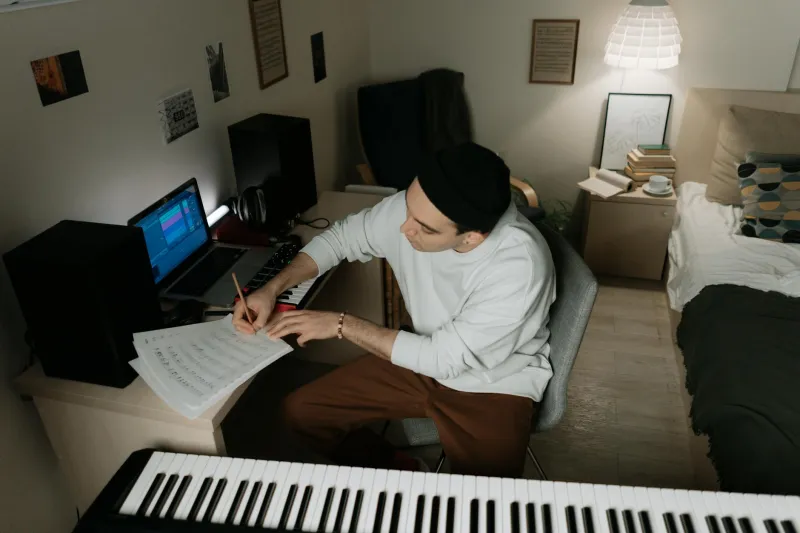
Meanwhile, in a bedroom studio in Hackney, 22-year-old producer Zara Blackwood (performing as Babble Fish) is creating entire concept albums in languages that shift and evolve from track to track. Her latest release, Polyglot Fever Dreams, features collaborations with AI text generators, creating a truly post-human approach to linguistic creativity.
"I started making music because I had things to say," Blackwood explains, "but then I realised that sometimes the most important things can't actually be said. They can only be felt."
The Beautiful Absurdity Continues
In an age of information overload, there's something deeply refreshing about artists who've chosen to communicate through pure sound and texture rather than competing in the endless noise of social media discourse. These nonsense prophets aren't trying to make statements about politics or society – they're making statements about the fundamental nature of human expression itself.
Perhaps that's why this tradition continues to thrive in Britain's underground scenes. In a country that gave the world both Shakespeare and Monty Python, there's always been an appreciation for the power of language – and the equal power of abandoning it entirely when the moment calls for something beyond words.
As Elizabeth Fraser herself once said in a rare interview: "Sometimes the most honest thing you can do is admit that what you're feeling doesn't have words yet. So you have to make them up."
In the end, maybe that's what all the best music does anyway – creates new languages for experiences we didn't know we were having.