The Unholy Trinity of DIY Initiation
There's a sacred trinity in UK DIY music that every proper musician must experience before they can call themselves battle-tested. First: playing a "gig" where the audience consists of the barman, your mate Dave, and someone's girlfriend who's clearly just waiting for you to finish so she can use the toilet. Second: loading your gear into a Transit van at 3am in a car park that smells suspiciously of piss and broken dreams. Third: discovering that your "dressing room" is actually a broom cupboard with a mirror that's seen more cocaine than a Britpop reunion tour.
These aren't deterrents — they're diplomas. And every musician worth their salt in this country has a collection of them that would make a war correspondent weep.
The Venue Lottery: From Glory Holes to Glory Days
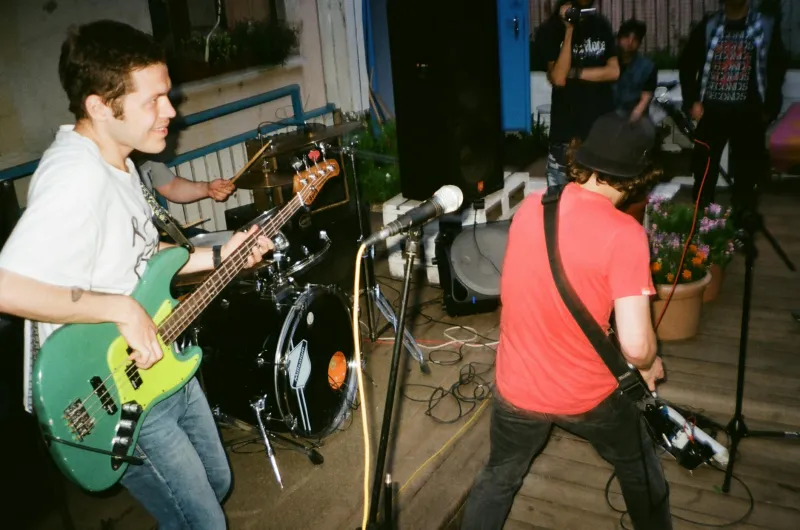
Let's start with venues, because Christ, where do you even begin? There's the pub in Stockport where the "stage" is literally three beer crates duct-taped together, and the PA system is older than most of the people reading this. The sound engineer is actually the landlord's nephew who once watched a YouTube video about mixing, and the lighting rig consists of a single red bulb that flickers ominously throughout your set like some sort of musical seizure warning.
Then there's the legendary toilet venues — and yes, they're called that for a reason. Not because they're metaphorically shit (though some are), but because they're often converted from actual public conveniences. Manchester's got at least three, Birmingham's got a couple, and London's got enough to constitute their own postcode. Playing one of these is like earning your musical driving licence — everyone's done it, nobody talks about it at dinner parties, but it's an essential rite of passage.
Sarah from Coventry band Hex Wraiths puts it perfectly: "Our first proper gig was in what used to be a Victorian pissoir. The acoustics were mental — all that tile work made everything sound like we were playing inside a toilet bowl. Which, technically, we were."
Van Life: The Mobile Torture Chamber
Ah, the band van. That noble beast of burden that's transported more dreams than a particularly ambitious removal company. Every UK musician has a relationship with a van that's more complex than most marriages. It's part transport, part storage unit, part mobile rehearsal room, and part psychological warfare device.
These aren't sleek tour buses with Wi-Fi and working toilets. These are Transit vans with names like "The Beast," "Shitbox Supreme," or simply "Dave" (after the bassist who somehow convinced everyone he knew about engines). They break down in the most inconvenient places — usually somewhere between Grimsby and nowhere, at 2am, in the rain, with a full backline and no breakdown cover.
The loading ritual is its own form of masochism. Tetris has nothing on trying to fit a drum kit, three amps, four guitars, a keyboard that nobody really needs but the songwriter insists on bringing, and five people's overnight bags into a space that was clearly designed by someone who'd never seen a musical instrument in their life.
The Audience Archaeology
Playing to nobody is an art form in itself. Not literally nobody — that would be easy. No, the real skill is in performing to an audience of three people who clearly didn't mean to be there. There's always the same cast of characters: the drunk regular who shouts requests for songs you've never heard of, the music blogger who spends the entire set taking notes on their phone (and never publishes anything), and the person who's obviously just using the venue as a shortcut to the chip shop.
But here's the thing — these gigs matter. They're where you learn to win over the unconverted, where you develop the stage presence that'll serve you when you finally graduate to venues with actual capacity numbers. Every major UK act has stories about playing to empty rooms, and they'll tell them with the same pride as their festival headline slots.
The Equipment Graveyard
Every DIY musician's bedroom looks like a musical instrument graveyard. There's the guitar with the dodgy input jack that only works if you hold the cable at exactly the right angle. The amp that's held together with gaffer tape and prayer. The drum kit that sounds like someone falling down a particularly musical staircase.
This isn't poverty — it's character building. Learning to coax magic from broken equipment teaches you more about music than any conservatoire ever could. When your distortion pedal only works if you kick it at precisely the right moment, you develop a relationship with your gear that goes beyond mere ownership into something approaching mysticism.
The Camaraderie of Chaos
What binds all this suffering together is the unspoken understanding between musicians who've been through it. There's a nod of recognition when you mention playing the Wheatsheaf in Stoke, or loading out at the Fighting Cocks in Kingston. These shared traumas create a network of mutual support that spans genres, generations, and geographical boundaries.
It's why established bands still help newcomers with gear loans and van shares. It's why venue owners who've seen a thousand bands come and go still give unknown acts a chance. And it's why British music culture remains so resolutely authentic — because everyone's earned their stripes in exactly the same gloriously grim way.
The Beautiful Brutality of It All
The truth is, this isn't suffering — it's selection pressure. The venues that shouldn't exist, the vans that barely work, the audiences that don't care — they're all part of a brutal but beautiful filtering system that ensures only the most committed, most creative, and most genuinely passionate musicians make it through.
When you've played a broom cupboard in Burnley to an audience of two and made them believe in your music, you can handle anything. When you've made a drum kit held together with hope and cable ties sound like thunder, you've learned something about resourcefulness that no amount of money can buy.
This is why British music punches so far above its weight internationally. It's not despite these ridiculous conditions — it's because of them. Every broken amp, every impossible load-in, every audience member who'd rather be literally anywhere else is forging musicians who can't be broken by mere adversity.
So here's to the toilet venues, the Transit vans, and the three-person audiences. Here's to the beautiful, brutal, utterly necessary chaos that turns bedroom dreamers into proper musicians. Long may it continue to produce the most authentically brilliant music on earth.