The Great Misunderstanding Principle
Britain's greatest musical moments have always happened by accident. While other nations plan their cultural victories with military precision, we stumble into genius through a combination of administrative incompetence, stubborn bloody-mindedness, and the sort of cheerful chaos that only emerges when someone books a noise band for a church fête.
This isn't just anecdotal evidence – it's practically a law of physics. The more inappropriate the venue, the more likely something magical will occur. It's as if the universe rewards those brave enough to play death metal to an audience expecting Morris dancing.
When Granny Met Grindcore: The Eastbourne Incident
Our first exhibit comes from Eastbourne, 2019, where administrative confusion led to the legendary pairing of Nottingham grindcore outfit Visceral Discharge with the Meads Community Centre's weekly tea dance. What should have been a cultural catastrophe instead became the most talked-about gig on the south coast.
The band, expecting a typical underground venue, arrived to find 40-odd pensioners arranged around tables laden with Victoria sponge. The pensioners, expecting their usual pianist Derek with his repertoire of wartime favourites, were confronted by four young men carrying what appeared to be medieval torture devices.
What happened next defies musical logic. Rather than fleeing, the band decided to honour their booking. They performed a 20-minute set of their most accessible material, which in grindcore terms means songs you can actually distinguish from industrial accidents.
The audience response was extraordinary. Edith Morrison, 78, was spotted headbanging during "Capitalist Decay." Frank Wheeler, a veteran of the Suez Crisis, declared it "better than the bloody Sex Pistols." By the end, half the room was attempting to mosh around their walking frames.
"They had more energy than most of our regular crowds," admitted drummer Jake Thornley. "Plus, Edith invited us back for her 80th birthday party."
The incident spawned three documentary films, a Radio 4 comedy series, and the annual "Granny Grind" festival, now in its fifth year.
Jazz Hands and Jelly: The Toddler's Birthday Breakthrough
Sometimes wrong venues create right audiences, as discovered by experimental jazz quartet Temporal Displacement when they accidentally gatecrashed three-year-old Maisie Chen's birthday party in Hackney.
The booking mix-up occurred when Maisie's mother contacted what she thought was a children's entertainment agency. Instead, she reached the personal phone of saxophonist Marcus Webb, who assumed she was booking his quartet for an avant-garde performance space called "The Little Angel."
The realisation dawned slowly. Webb and his colleagues arrived at a terraced house in Dalston expecting an intimate jazz venue. Instead, they found a living room full of toddlers high on sugar and helium balloons.
Professional musicians might have retreated. Temporal Displacement, however, saw opportunity. They performed a 45-minute improvised set that somehow perfectly captured the chaos of toddler consciousness. Their piece "Tantrum in B Minor" became an instant classic, later described by Jazz Journal as "the most honest expression of human emotion ever committed to saxophone."
The children were transfixed. Parents wept. One father, a music journalist for The Guardian, wrote a 3,000-word piece declaring it "the future of jazz." The band now exclusively performs at children's parties, having discovered that audiences under five possess the open minds that experimental jazz requires.
"Adults come with preconceptions," explains Webb. "Three-year-olds just experience the music. They're our ideal audience."
Death Metal Matrimony: The Wedding Reception Revolution
Perhaps the most legendary wrong-venue story involves Wolverhampton death metal duo Eternal Suffering, who were mistakenly booked for Sarah and Tom Henderson's wedding reception at a hotel in Telford.
The confusion arose from a telephone conversation between the wedding planner and the band's manager, during which "something heavy for dancing" was interpreted very differently by both parties. The bride expected a covers band playing crowd-pleasers. The band expected a metal festival afterparty.
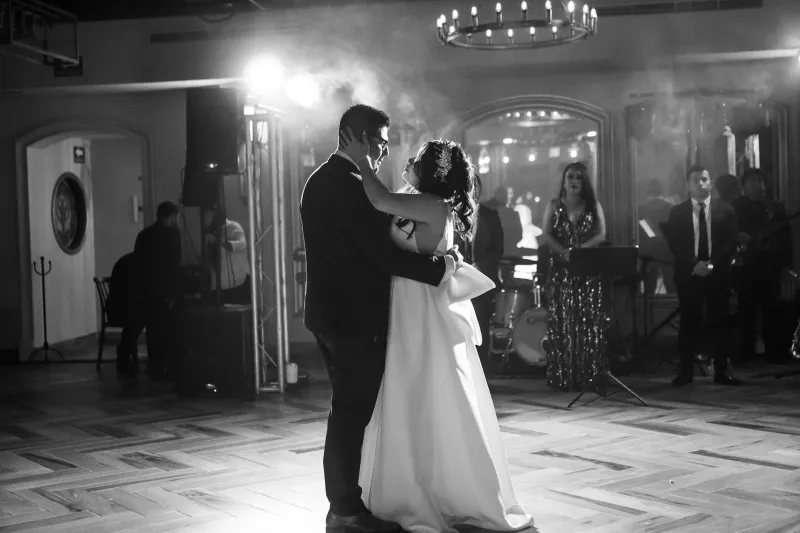
The moment of truth came during the first dance. As the happy couple prepared for a romantic waltz to "Wonderful Tonight," Eternal Suffering launched into "Apocalyptic Decimation," a seven-minute exploration of humanity's inevitable doom.
Rather than disaster, magic ensued. The bride, a secret metalhead who'd hidden her musical tastes for fear of family disapproval, began headbanging in her wedding dress. The groom, initially horrified, found himself swept up in the moment. Soon the entire wedding party was poggoing around the hotel function room, bouquets flying, morning suits dishevelled.
The band adapted brilliantly, performing acoustic versions of their most romantic death metal ballads. Their rendition of "Love Among the Corpses" became the couple's official wedding song. Video footage went viral, leading to bookings at 17 subsequent weddings.
"Turns out death metal is perfect for weddings," reflects guitarist Dave Skullfuck (legal name: David Smith). "Both celebrate life in the face of inevitable doom. Plus, the catering's usually better than our regular venues."
Funeral Jazz and the Celebration of Life
Not all wrong-venue stories involve inappropriate energy. Sometimes the mismatch works in reverse, as demonstrated when New Orleans-style jazz funeral band The Departed accidentally performed at what they thought was a celebration of life service in Brighton.
Instead, they'd been booked for the grand opening of a new Tesco Express. The supermarket's marketing team had requested "something celebratory with a community feel." The band's agent, mishearing "grand opening" as "grieving opening," dispatched them with their full funeral repertoire.
The result was surreal: shoppers entering to buy milk and newspapers were greeted by a full brass band playing "When the Saints Go Marching In" beside the self-service checkout. Rather than confusion, the performance created an atmosphere of genuine celebration.
Customers began dancing in the aisles. Staff joined in during their breaks. The store manager, initially panicked, realised he was witnessing something special. Sales figures for that day remain the highest in the branch's history.
The band now performs at supermarket openings across the South Coast, having discovered that retail therapy and musical catharsis share surprising common ground.
The Accidental Genius Principle
What these stories reveal is a fundamental truth about British music: our greatest innovations emerge from creative friction. When artists are forced to adapt to impossible circumstances, they discover possibilities that careful planning never reveals.
This principle extends beyond individual incidents. Britain's entire musical identity has been shaped by similar accidents of geography, class, and circumstance. Punk emerged from art school dropouts playing in pubs. Dubstep evolved from Jamaican immigrants experimenting in South London bedrooms. Britpop happened because Manchester bands couldn't afford to sound American.
The wrong venue, it turns out, is often exactly the right place. It strips away pretension, forces genuine connection, and creates the sort of shared experience that transforms music from entertainment into something approaching religious experience.
As Eternal Suffering's Dave Smith puts it: "We spent years trying to find our audience. Turns out our audience was at a wedding in Telford, waiting for us to show up."
In an industry obsessed with targeting demographics and market research, perhaps there's wisdom in embracing chaos. Sometimes the best way to find your people is to play for completely the wrong people and see what happens.
After all, this is Britain. We've been getting things gloriously wrong for centuries, and somehow it always works out brilliantly in the end.