The Shed Revolution
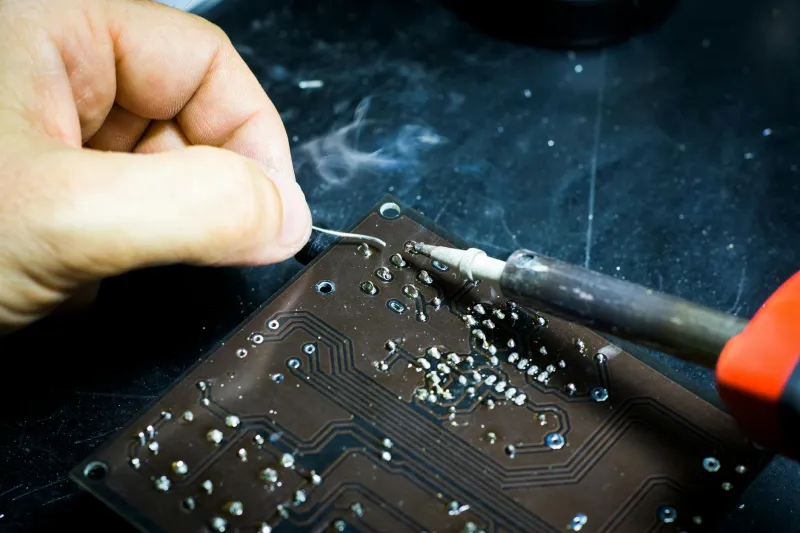
There's something distinctly British about turning your garden shed into a laboratory for sonic experimentation. While the rest of the world queues up for the latest Moog or Korg, a growing tribe of UK tinkerers are wielding soldering irons like lightsabres, transforming junk shop finds into instruments that would make Brian Eno weep with joy.
Meet Dave Thornton from Middlesbrough, whose converted garage houses what he calls 'The Frankencaster' — a guitar cobbled together from a 1970s radiogram, three broken calculators, and enough copper wire to rewire a small village. "I was skint, basically," Dave explains, adjusting a potentiometer that controls what sounds like a dying robot having an existential crisis. "Couldn't afford a proper synth, so I thought, 'Sod it, I'll build one.'"
The result? Sounds that hover somewhere between techno and the shipping forecast, delivered through what appears to be a Victorian science experiment gone wonderfully wrong.
Beyond the Circuit Board
While Dave's approach leans heavily on electronic mayhem, others are taking a more organic route. In a converted barn outside Bath, carpenter-turned-sound-sculptor Jenny Walsh crafts instruments from reclaimed timber that look like they've tumbled through a wormhole from some parallel folk tradition.
"I started with a broken dulcimer I found at a car boot sale," Jenny recalls, running her fingers along the curved neck of something that defies classification. "But why stick to conventional tuning when you can invent your own musical language?"
Her creations — part harp, part percussion, part alien communication device — have found their way onto recordings by everyone from experimental folk acts to post-punk revivalists. Each instrument is unique, unrepeatable, and utterly bonkers in the best possible way.
The Circuit Bending Brigade
Perhaps nowhere is Britain's DIY instrument obsession more evident than in the circuit bending community. These electronic archaeologists take discarded toys, radios, and keyboards, crack them open, and rewire them into glorious noise machines.
Take Marcus 'Sparky' Williams from Cardiff, whose spare bedroom resembles a toy shop explosion crossed with a NASA control room. Vintage Speak & Spells share shelf space with gutted Casio keyboards, each one lovingly modified to produce sounds their original designers never imagined.
"There's something beautiful about giving these forgotten gadgets a second life," Sparky explains, demonstrating a modified children's piano that now sounds like a dial-up modem having a breakdown. "Plus, you can't get this sound from any shop-bought synth. It's properly mental."
The Philosophy of Weird
What drives these sonic alchemists isn't just thrift or creativity — it's a fundamental rejection of musical orthodoxy. In a world where technology increasingly homogenises sound, Britain's DIY builders are gleefully swimming against the tide.
"Why would I want to sound like everyone else?" asks Sarah Chen, whose London flat doubles as a workshop for instruments that look like they've escaped from a steampunk fever dream. "Half the fun is not knowing what's going to come out when you flip the switch."
Sarah's latest creation — a hybrid of found electronics and salvaged piano strings — produces drones that could soundtrack either a meditation session or a horror film, depending on your perspective. It's this unpredictability that keeps her building, constantly chasing sounds that exist nowhere else on Earth.
From Shed to Stage
What started as bedroom tinkering is increasingly finding its way onto proper stages. Venues across the UK are hosting 'maker nights' where inventors showcase their sonic Frankenstein's monsters, while experimental labels actively seek out recordings made with homebrew instruments.
"There's a hunger for genuine weirdness," observes Tom Bridgewater, who runs irregular showcases at a converted pub in Manchester. "People are tired of the same old sounds. These builders are creating entirely new sonic territories."
The community aspect is crucial too. Online forums buzz with circuit diagrams, build guides, and recordings of successful experiments. It's collaborative chaos, with builders sharing techniques and inspiring each other to push boundaries further.
The Beautiful Madness Continues
As commercial music technology becomes increasingly polished and predictable, Britain's DIY instrument builders represent something vital — the beautiful madness of human creativity unleashed. They're not just making music; they're expanding the very definition of what music can be.
In sheds and spare rooms across the country, soldering irons are firing up, wood is being shaped, and circuits are being bent into impossible configurations. Each creation adds another voice to Britain's gloriously cacophonous underground symphony.
And long may the beautiful madness continue.