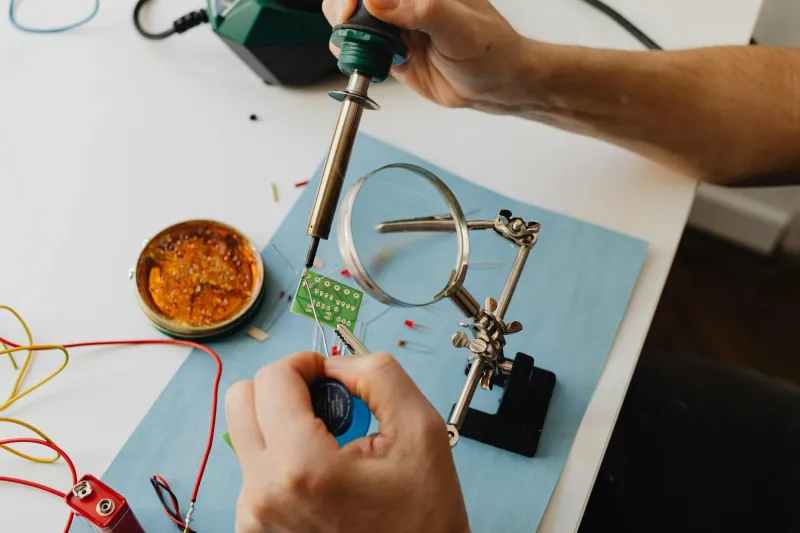
The Revolution Will Be Hand-Soldered
While the music industry obsesses over the latest overpriced boutique gear, something far more interesting is happening in the forgotten corners of Britain. In converted sheds, cramped bedrooms, and cluttered garages across the country, a quiet revolution is taking shape—one capacitor, one circuit board, one gloriously unstable oscillator at a time.
Meet the shed wizards: Britain's underground community of DIY synthesiser builders who've decided that if you want proper weird sounds, you'd better bloody well make them yourself.
"Commercial synths are all too polite," explains Sarah Chen, who builds modular noise generators in her Salford flat. "They're designed not to break, not to surprise you. But the best sounds come from accidents, from circuits that shouldn't work but somehow do."
Chen's latest creation looks like something a mad scientist would reject as too chaotic. A tangle of wires connects hand-etched circuit boards, salvaged radio components, and what appears to be the guts of a broken Speak & Spell. When she fires it up, the result is pure sonic alchemy—a burbling, growling, occasionally shrieking voice that sounds like R2-D2 having an existential crisis.
Beyond the Boutique
This isn't about saving money or sticking it to Moog. For Britain's circuit-bending community, building your own gear is equal parts artistic statement and philosophical stance. In an era where everything from your toaster to your car is locked down by manufacturers, soldering your own synthesiser becomes an act of beautiful defiance.
"There's something deeply satisfying about knowing every component in your instrument," says Marcus Webb, a Birmingham-based builder whose YouTube channel 'Proper Mental Modules' has become essential viewing for the DIY synth community. "When you've hand-wired every connection, you understand the soul of the machine. You know exactly which knob will make it scream."
Webb's workshop reads like a love letter to electronic chaos. Shelves groan under the weight of vintage chips salvaged from defunct arcade machines, while workbenches overflow with half-finished projects that blur the line between musical instrument and modern art installation. His latest obsession involves circuit-bending children's toys—transforming innocent Fisher-Price keyboards into snarling noise demons.
The Shed Scene
What started as isolated tinkering has evolved into a proper community. Online forums buzz with circuit diagrams and troubleshooting advice, while monthly meet-ups in pubs across the country have become essential networking events for the electronically minded. The annual 'Bent Festival' in Manchester draws hundreds of makers, each clutching their latest sonic abomination with the pride of a new parent.
"The community aspect is massive," explains Jenny Rodriguez, who organises build workshops in her Leicester makerspace. "You'll have a 16-year-old showing a pension-age engineer how to bend a Game Boy, while someone else demonstrates their latest Eurorack module built from recycled washing machine parts. It's brilliant chaos."
The workshops have become breeding grounds for increasingly ambitious projects. Recent builds include a synthesiser controlled by plant bio-rhythms, a drum machine that samples breaking glass, and something called the 'Brexit Box'—a noise generator that becomes more unstable the longer you leave it running.
Sounds Like Nothing Else
But here's the thing that really matters: these homemade contraptions are producing sounds that simply don't exist anywhere else. When you're not bound by commercial considerations or safety regulations, when you're free to experiment with unstable circuits and impossible component combinations, magic happens.
Take Glasgow's Tom McKenzie, whose 'Haggis Synthesiser' incorporates actual bagpipe components alongside traditional electronics. The result defies classification—part drone, part melody, entirely Scottish, and utterly mental. Or consider the London collective 'Static & Hum,' whose collaborative noise installations use dozens of interconnected homemade modules to create evolving soundscapes that can run for hours without repetition.
"We're not trying to recreate vintage sounds or compete with commercial gear," McKenzie explains. "We're trying to make sounds that have never existed before. That's the whole point."
The Future is DIY
As streaming platforms homogenise music and AI threatens to automate creativity, Britain's DIY synthesiser community represents something precious: the stubborn insistence that the best art comes from human hands and brilliant mistakes. These aren't just instruments—they're statements of intent, proof that in an increasingly digital world, the most interesting sounds still come from actual wires and real components.
The movement shows no signs of slowing. Online component suppliers report booming sales of specialist chips and vintage parts, while electronics courses at universities are seeing renewed interest from students more interested in making noise than following curricula.
"Every time someone builds their own synth, they're adding something new to the sonic palette of music," reflects Chen, adjusting a knob on her latest creation and unleashing a sound like digital bagpipes being fed through a broken vocoder. "And that's exactly what music needs—more weird, more wonderful, more completely bloody mental."
In a world of preset sounds and algorithmic recommendations, Britain's shed wizards are keeping the spark of genuine sonic discovery alive. One hand-soldered connection at a time.