Tape Worms: Inside Britain's Obsessive Cassette-Raiding Remix Underground
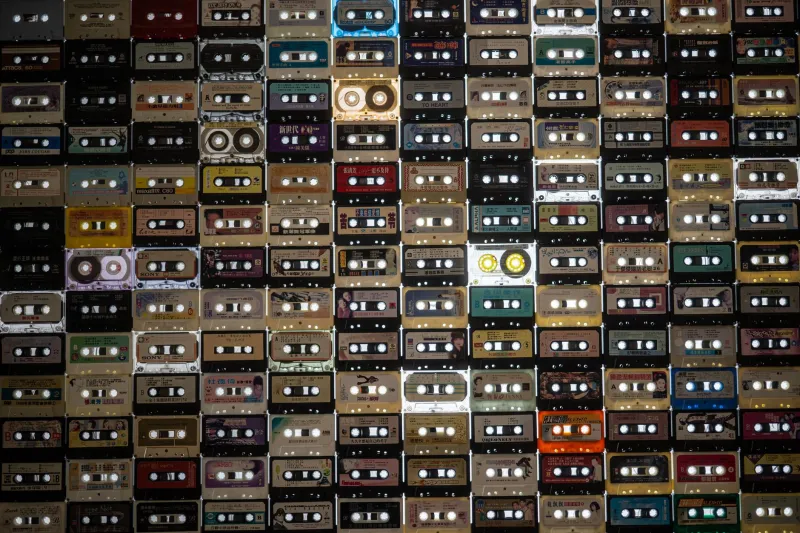
There's a particular kind of Saturday morning ritual that most people associate with charity shops: the slightly damp smell, the overstuffed rails of fleece jackets, and that one ceramic cat that's been there since 2009. But lurking near the back, usually wedged between a VHS copy of Cocktail and a bag of unsorted jigsaws, is a crate of cassette tapes that nobody has touched in fifteen years.
For most shoppers, that crate is invisible. For a growing underground of British musicians and producers, it's a goldmine.
The Hunt
Meet Donna, a 34-year-old producer from Wolverhampton who goes by the name Cassette Cassandra online and refuses to give her surname because, as she puts it, "my mum still thinks I work in admin." Every weekend, she trawls through at least four charity shops in the West Midlands, spending no more than 50p per tape. Her haul last month included a 1987 wedding reception recording from Dudley, a homemade ambient album pressed by a local church group in Walsall, and a baffling instructional tape for learning conversational Portuguese that someone has clearly used to also record over chunks of what sounds like a brass band rehearsal.
"That last one is the one," she says, eyes genuinely lighting up. "You've got this bloke saying 'onde fica a farmácia?' and then suddenly there's a trombone. Nobody planned that. That's the most interesting musical accident I've found in years."
Donna isn't alone. Across the country — from Dundee to Doncaster, from Swansea to Southend — a loose, largely unorganised community of producers is doing the same thing. They share finds on private Discord servers and obscure Reddit threads, swap duplicates by post, and occasionally meet at tape fairs to compare notes with the barely-suppressed excitement of people who've genuinely found treasure.
The Process
What happens to the tapes once they're rescued from the 50p crate is where things get genuinely strange and genuinely brilliant.
Some producers sample the tapes directly — lifting a phrase, a chord, a cough, a room tone — and loop it into something new. Others run the tapes through degraded Walkman decks deliberately, using the warble and wow-and-flutter of worn-out playback mechanisms as an instrument in themselves. A few, like Marcus from Bristol who records under the name Oxfam Rave, play the tapes at wrong speeds, stack multiple recordings simultaneously, and then feed the resulting chaos through modular synths.
"It's like archaeology but destructive," Marcus admits cheerfully. "I'm technically ruining these recordings. But I'm also making sure they exist in some form. If I hadn't bought that tape of someone's 1993 caravan holiday singalong, it would've ended up in landfill. Now it's in a twelve-minute piece I performed at a festival in Stroud. Is that better? I think it's better."
The ethical dimension here is genuinely interesting, and the community debates it constantly. Are they honouring forgotten artists by sampling them, or appropriating them without consent? Most of the people on these tapes are anonymous — amateur musicians, bedroom experimenters, people who recorded themselves singing for fun on a Sunday afternoon in 1991 and never expected anyone to hear it again. There's no label to clear, no artist to contact, no estate to consult.
The Sound
What's emerging from all this tape-raiding is something genuinely difficult to categorise, which — let's be honest — is exactly why we're writing about it.
The music that producers like Donna and Marcus are making sits somewhere between hauntology, lo-fi hip-hop, musique concrète, and something that doesn't have a name yet. It's saturated in a very specifically British kind of nostalgia — the sound of community centres, of amateur dramatics, of Christmas parties in function rooms with carpets that haven't been replaced since Thatcher was in office. But it's also forward-facing, genuinely experimental, and occasionally absolutely banging.
There are nights — loosely organised, poorly advertised, usually in pubs with functioning projectors — where producers play live sets using only cassette sources. The aesthetic is part performance art, part comedy, part something that makes your chest feel strange in a way you can't immediately explain. Watching someone loop a snippet of a 1986 children's choir over a four-four kick drum while a grainy photo of a parish hall is projected behind them is, against all odds, profoundly moving.
The Accidental Archive
Perhaps the most remarkable thing about this scene isn't the music it's making — it's the music it's accidentally preserving.
Because these producers document everything. Every tape gets logged, catalogued, and digitised before it's sampled or mangled. The original recording is kept intact. Several members of the community have started uploading unaltered tape finds to archive.org, creating a sprawling, chaotic, utterly fascinating document of British amateur music-making across four decades.
It's an archive that no institution thought to build. It exists because a bunch of people with Walkmans and 50p decided that the contents of a charity shop crate were worth caring about.
That's not nothing. That's actually quite a lot.
"Someone's nan recorded herself singing Danny Boy in a kitchen in 1988," Donna says, scrolling through her archive on her phone. "She probably thought nobody would ever hear it. Millions of people recorded themselves doing things like that and then the tapes just... disappeared into charity shops. We're finding them. We're listening. I think that matters."
She's right. It absolutely does.