The Room Is Lying to You: Britain's Magnificently Broken Venues and the Sounds They Accidentally Invented
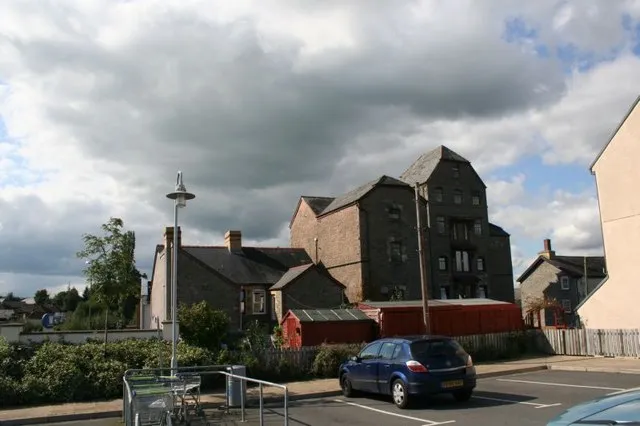
Photo: Bill Nicholls, CC BY-SA 2.0, via Wikimedia Commons
A proper acoustic consultant would walk into The Barrel Room beneath a pub in Bristol, take one look at the ceiling — which slopes at an angle that suggests the building above it is slowly winning an argument with gravity — and leave immediately. The walls are bare brick on three sides and inexplicably covered in 1970s carpet tiles on the fourth. There is a supporting pillar positioned almost exactly where the mixing desk needs to be. The floor, for reasons nobody has ever satisfactorily explained, is slightly higher at the back than the front.
It is, by every measurable standard, an acoustic disaster.
It is also, by the testimony of every musician who has played it in the last fifteen years, one of the most interesting-sounding rooms in the south of England.
This is not a coincidence.
Britain's Glorious History of Getting It Wrong
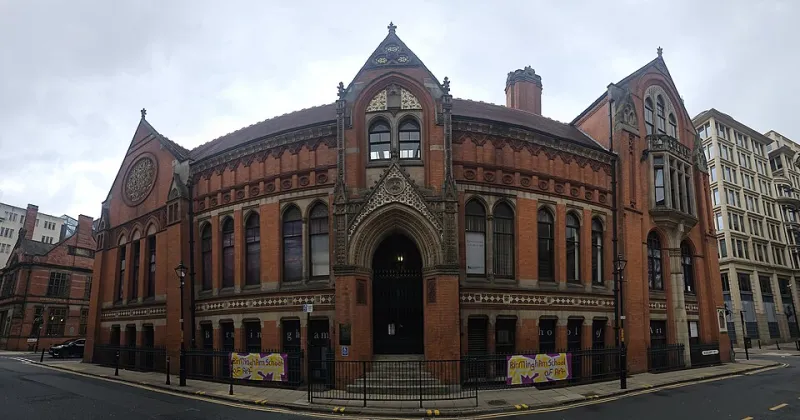
There is a reason British experimental music sounds the way it does, and that reason has very little to do with talent, equipment, or intention. It has everything to do with the rooms. Specifically: the wrong rooms. The rooms that were built for something else entirely — grain storage, light industry, nonconformist worship, municipal recreation — and were subsequently pressed into musical service with absolutely zero acoustic consideration.
Britain has an extraordinary density of these spaces. Victorian civic architecture produced buildings with dimensions that make no acoustic sense. Post-war community centres were built to budgets that precluded anything as luxurious as sound absorption. Converted industrial spaces in cities like Leeds, Manchester, and Glasgow retained their original proportions — which were optimised for machinery, not music — long after the machinery departed.
The result is a national landscape of performance spaces that are, acoustically speaking, completely barmy. And musicians, being the adaptable creatures they are, made art out of the chaos.
The Asymmetry Advantage
Sound engineer Priya Nair has spent twelve years working in unconventional venues across the Midlands and North of England. She has mixed shows in a converted abattoir in Sheffield (parallel walls, extremely live surfaces, a bass response that she describes as "like being inside a kick drum"), a Victorian swimming baths in Huddersfield that was drained but never repurposed (the empty pool creates a reverb tail of approximately four seconds), and a Quaker meeting house in York where one wall is three feet thicker than the others due to a 19th-century structural repair.
"Every bad room teaches you something a good room can't," she says. "In a properly treated space, the room disappears. Which is the point, acoustically. But when the room is fighting you, you have to fight back, and the things you discover in that fight are genuinely interesting."
The Huddersfield swimming baths show is a particular favourite. A drone ensemble from Leeds performed there in 2019, and the four-second reverb tail — which Nair initially tried to compensate for — eventually became the compositional centrepiece. The musicians began playing with the decay rather than against it, spacing notes and phrases to interact with the room's response. The result was something neither the performers nor the engineer had planned: a piece of music that was co-written, in real time, by the building itself.
Maps of Impossible Rooms
Spend time talking to musicians who operate on Britain's experimental circuit and a map begins to emerge — an informal geography of sonically peculiar venues that gets passed between artists like a secret.
There's a church hall in Peckham where a badly installed suspended ceiling creates a resonant frequency at exactly 63Hz, meaning any music with significant bass content produces an additional unpredictable drone from the ceiling tiles. Several artists have started incorporating this into their performances deliberately, treating the room as an instrument.
There's a former textile mill in Halifax where the original loading bay doors — enormous, heavy, timber-framed — are still functional, and opening or closing them mid-performance changes the room's acoustic character substantially. One regular performer there has made door operation part of their live set, with a dedicated crew member managing the doors as a performative element.
And there's a basement venue in Edinburgh — the name of which its regulars are disinclined to share publicly, partly out of protectiveness and partly because the building's planning status is somewhat ambiguous — where the ceiling is so low in one corner that performers must crouch, and the resulting intimacy between performer and audience, combined with a peculiar mid-frequency buildup caused by the room's irregular dimensions, creates an intensity that larger, more conventional spaces simply cannot replicate.
The Sound Engineers Who Learned to Stop Fighting
The conventional response to a bad acoustic environment is treatment: absorption panels, diffusers, bass traps. Throw enough material at a room and you can, in theory, flatten its response. But a growing number of sound engineers working on Britain's independent circuit have concluded that this approach, while acoustically correct, is creatively limiting.
Jim Calder, who has been engineering live sound in Scotland for twenty years, puts it bluntly: "Treated rooms sound like treated rooms. They sound like anywhere. The interesting rooms sound like themselves."
Calder's approach to difficult spaces is to spend the first hour of any setup simply listening — walking the room, clapping, speaking, playing single notes through the PA — to understand what the space is doing before trying to do anything to it. "You're looking for what the room wants to amplify. Every room has things it likes. You find those things and you lean into them."
This is, essentially, the same approach that generations of musicians have arrived at independently. The room is not a neutral container for music. It is a participant. In imperfect rooms, it is an opinionated, unpredictable, sometimes infuriating participant — but one that consistently demands creative responses that perfect spaces never would.
Why the Perfect Room Is the Wrong Room
There's a broader point here that goes beyond acoustics. Britain's experimental music scene has always thrived in spaces that weren't built for it, and that relationship has been generative in ways that extend beyond sound. Unconventional spaces attract unconventional audiences. They signal, by their very nature, that normal rules don't apply. They create permission.
The room that's slightly wrong — the one where you can't quite stand comfortably, where the sound does unexpected things, where the infrastructure of the building keeps making itself known — keeps everyone present. Performer and audience alike are reminded that they are in a specific place, at a specific time, experiencing something that can't be reproduced elsewhere.
Which is, when you think about it, exactly what live music is supposed to do.
The perfect room is a lie. Britain's lopsided, asymmetrical, acoustically chaotic venues have been telling the truth for decades.