Bolt the Door, Start the Set: Mourning Britain's Vanishing Lock-In Gig
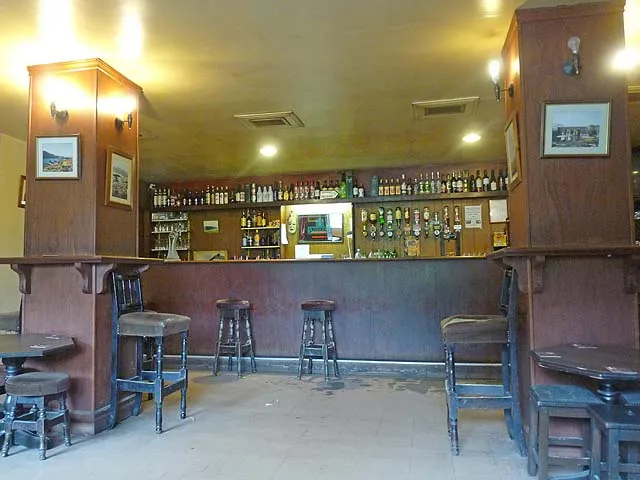
Photo: Oliver Dixon , CC BY-SA 2.0, via Wikimedia Commons
Bolt the Door, Start the Set: Mourning Britain's Vanishing Lock-In Gig
The curtains come down. The bolts go across. Someone turns the main lights off and whoever's running the night gives a nod that means — without anyone needing to say it aloud — that the rules have changed. What happens in the next two hours is technically illegal, definitely sweaty, and occasionally life-altering. This is the lock-in gig. And it is dying.
Britain's after-hours pub session has never been a formally recognised institution. That's rather the point. It existed in the gap between licensing law and human need, in the space between what was permitted and what was necessary. It was where musicians played for people who'd already decided they weren't going home, in rooms that smelled of spilled bitter and old wood, to audiences who were half-cut enough to listen without self-consciousness and sober enough to remember it the next morning.
And it produced, with almost alarming regularity, some of the most adventurous, uncompromising, and genuinely strange music this country has ever made.
The Physics of the Lock-In
There's a specific acoustic and social dynamic to the lock-in that you can't manufacture. The room is small. The audience is captive — not literally, but nobody's leaving because there's nowhere else to go and the beer is still flowing. The performer knows this. The performer also knows that there's no festival booker watching, no A&R person with a notepad, no social media clip that's going to make or break a career. There's just the room.
This creates a kind of creative freedom that's genuinely rare. Musicians who spent their regular sets playing it relatively safe — keeping the weird stuff for the encore, if they even bothered with it — would let themselves go completely in a lock-in context. New songs that weren't ready for public consumption. Extended improvisations that would have cleared a festival tent. Cover versions so radically deconstructed they became something else entirely.
Jamie Norris, who ran the back room of a pub in Leeds through most of the 2000s and 2010s, describes it as "the only honest version of a gig that exists. Everything else is performance. The lock-in is where the performance stops and the music starts."
Thirty People and a Legend
Ask around in any British city with a half-decent music history and you'll find people who'll tell you, in hushed tones, about a lock-in session they witnessed that changed something in them. A night where a band played for two hours straight to twenty-five people and invented something new in real time. A solo performer who dismantled their own set halfway through and rebuilt it from scratch because the room demanded it.
These stories accumulate. They become part of the mythology of British underground music — the invisible infrastructure behind the official narrative. The sessions that never got reviewed, never got recorded, never got a Wikipedia entry, but that fed directly into the records and the movements and the careers that did.
The lock-in was, in this sense, a research and development facility disguised as a licensing violation. It was where the risks got taken that couldn't be taken anywhere else.
The Closure Crisis and Its Consequences
The numbers are grim. Britain has been losing pubs at a rate that should be treated as a national emergency and largely isn't. Thousands of venues have closed in the past decade alone, casualties of rising rents, business rates, changing drinking habits, and a planning system that seems constitutionally incapable of recognising what a pub actually is.
Every pub closure is a loss of community infrastructure. But for music, each one also represents the disappearance of a potential lock-in space — a room where the after-hours experiment could happen. These rooms aren't being replaced by anything equivalent. Music venues with licences and sound systems and booking infrastructure are a different thing entirely. They're important, obviously, but they operate on different terms. The lock-in's power came precisely from its informality, its illegality, its smallness.
What's replacing it? Partially, nothing. Partially, the house party — which has its own virtues but lacks the specific neutrality of the pub, the sense of a shared space that doesn't belong to anyone in particular. Partially, online streaming, which is obviously a different thing and doesn't bear comparison.
Some promoters are trying to recreate the lock-in spirit in licensed late-night spaces, running small-capacity after-hours events with that same intimate, anything-goes energy. It's admirable, and some of it is genuinely good. But there's something about the specific transgression of the lock-in — the bolted door, the drawn curtain, the collective decision to stay past when you were supposed to — that can't quite be replicated when everything's above board.
What the Lock-In Knew That We've Forgotten
Here's what the lock-in understood, and what we're at risk of forgetting: the best music happens when the stakes are low and the freedom is high. When there's nothing to lose and nobody keeping score. When the audience is small enough that the performer can actually see everyone in the room and respond to them as individuals rather than playing to an anonymous crowd.
Festivals are spectacular, but they're not intimate. Streaming is convenient, but it's not communal. The lock-in was neither spectacular nor convenient. It was cramped and warm and slightly chaotic and entirely unpredictable, and it was, in its own way, irreplaceable.
Somewhere in Britain tonight, there's probably still a pub where the bolts are going across and someone's setting up in the corner. Hold onto it. These rooms are going, and we won't fully understand what we've lost until the last one's gone.