Buffering Beautiful: The Glitchy, Pixelated Sound of Britain's Digitally Abandoned
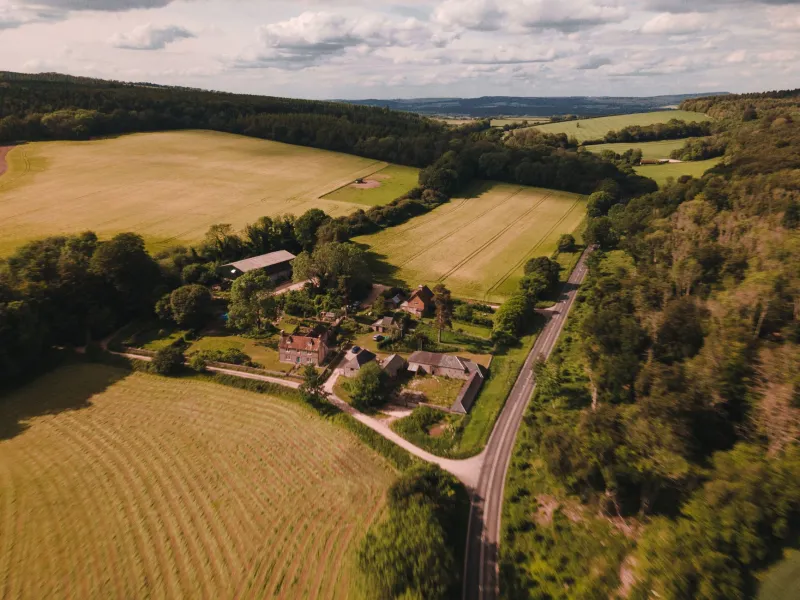
Picture the scene. You're in a farmhouse outside Dolgellau, north Wales, at half eleven on a Tuesday night. You've got a track nearly finished — just needs the vocal layer bounced down and sent to a collaborator in Bristol. Your broadband connection is running at approximately the speed of a wet envelope sliding down a wall. The upload fails three times. On the fourth attempt, the file corrupts mid-transfer and arrives as something that sounds like a dial-up modem having a breakdown.
Your collaborator messages back: what is this, it sounds incredible, can you do the whole album like this.
This is, more or less, how an entire sonic aesthetic was born.
The Geography of Bad Signal
Britain's digital infrastructure is, to put it diplomatically, uneven. Ofcom data consistently shows that rural areas lag significantly behind urban centres in broadband speeds, with some communities in Wales, northern Scotland, and parts of the English countryside operating at connection speeds that would have been considered inadequate fifteen years ago.
For most people, this is simply a frustration. For a specific subset of musicians operating in these areas, it has become something considerably more interesting: an involuntary sonic signature.
The compression artefacts that appear when audio files are squeezed through narrow bandwidth pipes. The glitching that occurs when streaming audio stutters and recovers. The particular quality of recordings made on budget interfaces through patchy connections, with the digital clipping and aliasing that results from pushing cheap converters too hard. These aren't problems that can be fixed with better technique. They're structural features of making music in digitally underserved Britain.
And some artists have decided to stop fighting them.
The Accidental Aesthetic
Musician and producer Rhiannon Rees lives and records in a village in the Brecon Beacons with a broadband connection that, she reports cheerfully, "gives up completely whenever it rains, which in the Beacons is most of the time."
Her solution was initially pragmatic: record everything locally, keep file sizes small, work with the constraints rather than against them. The unintended consequence was a sound that's become her most recognisable quality — heavily compressed, slightly degraded, with a digital graininess that sits somewhere between lo-fi bedroom pop and the kind of glitch music that producers in Berlin spend thousands on plugins trying to achieve.
"People ask me what plugins I use for that texture," she says. "The honest answer is: Welsh weather and a router from 2019."
The comparison to deliberately manufactured lo-fi aesthetics is worth sitting with. There's an entire cottage industry of plugins, presets, and production tutorials dedicated to adding digital degradation to pristine recordings — making clean audio sound like it's been through something. Artists in poor-connectivity areas are getting the real thing for free, as a byproduct of simply existing where they exist.
Isolation as Studio
The bandwidth issue is only part of the story. Geographic isolation brings its own sonic consequences that go beyond the technical.
Musicians working in rural areas of Britain report a fundamentally different relationship to influence and reference. Without easy access to the cultural churn of cities — the nights out, the support slots, the casual osmosis of being around other musicians — their work develops in a kind of controlled isolation. Ideas don't get workshopped into acceptability. Weird instincts don't get smoothed away by peer feedback. The music that comes out is frequently stranger and more specific than anything shaped by urban music community consensus.
Scottish producer and ambient artist Callum Dreich, based outside Ullapool in the northwest Highlands, describes his creative process as essentially solitary in a way that urban producers simply can't replicate.
"The nearest venue is forty minutes away on a good road. The nearest other musician I know personally is about the same distance in the other direction. I'm not going to gigs every week, I'm not in studios with other people, I'm not constantly absorbing what everyone else is doing. What comes out is just... mine. For better or worse, there's nobody else's fingerprints on it."
His work — dense, atmospheric, built from field recordings and heavily processed synthesiser — has found a devoted audience online, which is somewhat ironic given how difficult getting online remains for him. He uploads new material in batches when he visits Ullapool, using the café WiFi.
The Glitch as Grammar
What's emerged from the collision of poor connectivity, geographic isolation, and the particular stubbornness of artists who refuse to be defined by their limitations is something that resists easy genre categorisation — which, frankly, is our favourite kind of thing.
There are elements of glitch and microsound. Elements of lo-fi pop and bedroom recording culture. The specific quality of audio that's been compressed, decompressed, corrupted slightly, and reconstituted. The textural richness of recordings made in non-studio environments — kitchens, sheds, the back seats of parked cars — where the acoustic environment is part of the sound rather than something to be eliminated.
And running through all of it, the unmistakeable quality of work made by people who are genuinely far away from the mainstream conversation, doing things their own way because they literally don't have another option.
There's a producer based outside Hexham in Northumberland — she goes by the name Faultline, which seems apt — whose recent cassette release has been doing the rounds on the more adventurous end of the UK music press. The sound is built almost entirely from recordings made on her phone, processed through a free DAW on a laptop that's older than some of the people reviewing it, and uploaded to Bandcamp in the early hours when her connection is slightly less catastrophic than usual.
It sounds like nothing else. It sounds specifically like Northumberland, like isolation, like the particular texture of making something in conditions that weren't designed for making things.
What the Cities Are Missing
The irony isn't lost on anyone paying attention. Urban music culture has spent years chasing authenticity — lo-fi aesthetics, analogue warmth, the deliberate roughness that signals realness and independence. Meanwhile, in the parts of Britain that broadband forgot, artists are producing work with an authenticity that can't be manufactured because it comes directly from the conditions of their lives.
You can buy a plugin that adds vinyl crackle. You can't buy the particular digital smear that comes from uploading a track through a rural Welsh broadband connection at midnight in November.
The bandwidth rebels aren't making a point about infrastructure inequality, although perhaps they should be. They're just making music with what they have, in the places they are, through the connections they've got. The fact that it sounds extraordinary is, at this point, barely a surprise.
Weird sounds, remember. No apologies.