Mud, Mics and Machines: The Archivists Turning the British Countryside Into Electronic Music's Final Frontier
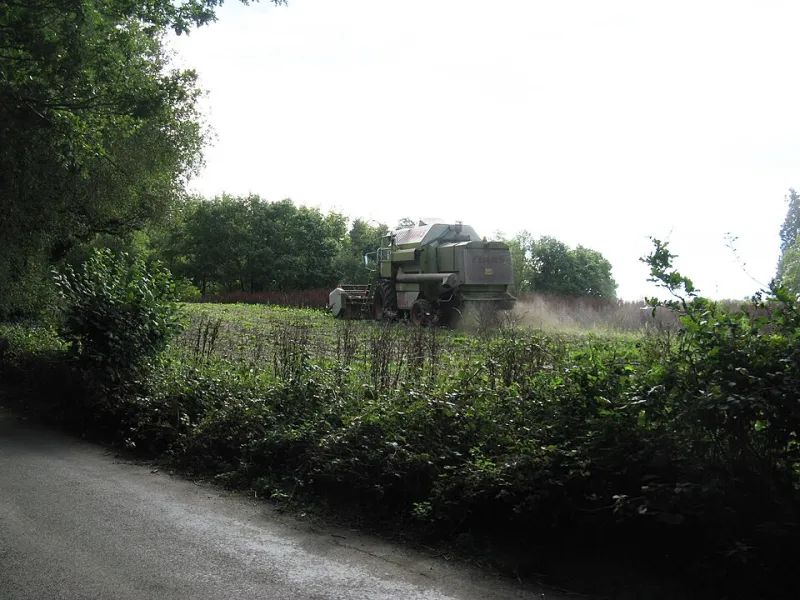
Photo: Dave Spicer , CC BY-SA 2.0, via Wikimedia Commons
For years, field recording had a postcode problem. If you wanted to make serious, chin-stroking sound art in Britain, you pointed your recorder at a city. The Northern Line at rush hour. The bell of a Liverpool casino spilling onto Lime Street. Rain on a Manchester bus shelter, if you were feeling poetic.
But something's shifted. Out in the shires, a loose network of producers, archivists and general eccentrics has decided the real sonic frontier isn't the city at all. It's the countryside — and it's disappearing faster than anyone can record it.
The Combine Harvester Is an Instrument If You're Brave Enough
Talk to the people doing this and one thing becomes clear fast: rural Britain is loud. Not loud like a club night, loud like a living thing. A combine harvester working a dawn shift in the Fens has a low-end rumble you could build an entire drone record on. A cattle market in Frome is basically freeform percussion — gates, hooves, auctioneers rattling through numbers at a pace that makes jungle MCs sound leisurely.
One collector we spoke to, who records under a name he asked us not to print because 'the parish council reads everything', has spent four years documenting church bells across the Welsh borders. Not the nice, ringing, postcard bells — the cracked ones, the half-muffled ones, the ones rung by three people instead of twelve because the tower's band has halved since 2010. 'A bell that's cracked tells you more about the village than any heritage plaque,' he says. 'It's got a wound. You can hear it.'
Vanishing Acts
There's an urgency here, and it's not aesthetic posturing. Agricultural Britain is being erased in real time. The hand-milking parlours are gone. The stockmen are retiring. The sounds that defined the countryside for centuries — the specific clatter of a chain-driven hay lift, the dialect patter of an auctioneer who learned his trade from his dad — are down to their last few custodians.
That's why these recordings matter as more than raw material. Several of the collectors we spoke to see themselves as archivists first and musicians second. One, based in Somerset, has over 600 hours of farm recordings digitised and backed up twice, and has released precisely one 12-inch. 'The archive is the work,' she told us. 'The record is just the receipt.'
It's a mentality straight out of the tape underground — the same obsessive, thank-you-for-your-service energy that keeps Britain's lost music off the skip. Except this time the lost music is being lost now, and the only person with a recorder in the right place is some bloke in a waxed jacket with a Zoom H5 in his pocket.
From Sheep Field to Dancefloor
Here's where it gets properly Nutty. These recordings aren't sitting in drawers. They're ending up in music — genuinely good music. Producers are pitching cattle market chatter into percussion. Someone's made a whole track from the mechanical wheeze of a 1970s turnip sorter. A collective in Yorkshire runs a night where rural field recordings get fed through modular synths live, and apparently it goes off.
And why not? The countryside has texture the city can't touch. Urban field recordings are all surfaces — traffic, tannoy, footsteps. Rural sound has weather in it. Wind through a hedgerow behaves differently to wind down a high street. A village green on fete day is a whole composition: brass band drifting out of sync with the generator, kids screaming, the specific flat clunk of a coconut shy.
There's also the simple fact that almost nobody's done it properly yet. The city has been recorded to death. The countryside is a blank map with a few very determined cartographers.
The Last Unexplored Frontier
The romantic reading is that British electronic music, having mined the urban experience to bedrock, is finally coming home — literally. The less romantic reading is that these artists just go where the interesting sounds are, and right now the interesting sounds are standing in a field near you, lowing.
Either way, the work being done down those muddy lanes is some of the most vital, weird and quietly political music in the country. Because when the barns fall down and the auctioneers retire, the recordings are all that's left. And if a banger gets made out of a sheep baa along the way?
No apologies.