Sacred Spaces: How Britain's Forgotten Function Rooms Became Musical Holy Ground
The Holy Trinity of Unlikely Venues
Forget the Roundhouse. Sod the O2. Britain's most genuinely transformative musical moments have happened in places that were never meant to host music at all. We're talking about the bingo halls that became acid house cathedrals, the bowling alleys that birthed post-punk legends, and the betting shops where tomorrow's sounds were hammered out above the fruit machines' electronic bleeps.
These weren't venues in any conventional sense. They were accidents waiting to happen — spaces pressed into service by necessity, desperation, or sheer bloody-mindedness. And they've shaped British music in ways that no purpose-built concert hall ever could.
When Bingo Became Bass
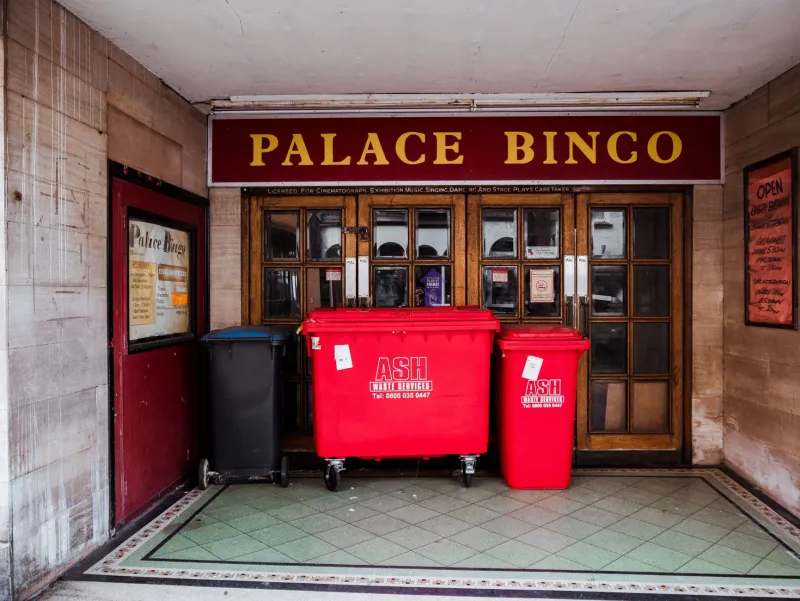
The transformation of Mecca Bingo halls into rave venues during the late 80s wasn't planned by any marketing department. It happened because promoters needed spaces that were big enough, cheap enough, and ignored enough by the authorities to host the kind of events that would've been shut down anywhere else. The irony was perfect: pensioners calling numbers by day, ravers losing their minds by night, same space, completely different universe.
Take the legendary Shelley's Laserdome in Stoke-on-Trent. Originally a bingo hall, it became the epicentre of the Northern rave scene purely because nobody else wanted it. The acoustics were terrible, the heating was broken, and the carpet was older than most of the punters. But something magical happened when that space filled with smoke machines and 909 kick drums. The mundane became transcendent.
 Photo: Shelley's Laserdome, via i.pinimg.com
The venue's regulars still talk about it with religious reverence. Not because it was comfortable or convenient, but because it was theirs. A space that existed outside the normal rules, where the only requirement was showing up and losing yourself in the madness.
The Bookies' Back Room Revolution
Whilst everyone was looking at Camden and Shoreditch, some of Britain's most innovative musicians were rehearsing above high street betting shops. The rent was cheap, the soundproofing was non-existent, and the atmosphere was thick with the smell of stale cigarettes and broken dreams. Perfect conditions for creating something genuinely different.
The Fall famously rehearsed above a William Hill in Prestwich for the better part of a decade. Mark E. Smith claimed the constant background noise of punters arguing about horse racing informed their sound. Whether that's true or just typical Smith mythology doesn't matter — what matters is that these unglamorous spaces gave bands the freedom to experiment without worrying about disturbing the neighbours or impressing industry types.
 Photo: Mark E. Smith, via www.donnapop.it
Because nobody expected anything good to come from a rehearsal room above a betting shop, there was no pressure to conform. Bands could spend months developing genuinely mental ideas, safe in the knowledge that the only people listening were the blokes downstairs trying to pick winners.
Bowling for Britain
Bowling alleys presented a different kind of opportunity. These were spaces designed for entertainment, but entertainment of a very specific, very British kind — the sort of place where office parties went to die and birthday celebrations turned awkward. The acoustics were mental, the lighting was harsh, and the atmosphere was absolutely perfect for the kind of confrontational performance art that was emerging from Britain's art school underground.
The legendary Croydon Bowling Centre became an unlikely hub for experimental music in the early 90s, hosting everything from industrial noise sessions to avant-garde poetry nights. The venue's management had no idea what they were letting themselves in for when they agreed to rent out the space on quiet weeknights. They probably thought they were getting nice, respectable cultural events. Instead, they got some of the most challenging and innovative performances of the decade.
 Photo: Croydon Bowling Centre, via media.routard.com
The beautiful thing about these bowling alley gigs was the complete disconnect between the setting and the content. Watching a noise artist perform a 40-minute piece about urban alienation whilst surrounded by cartoon graphics and the ghost smell of chip shop curry is a uniquely British experience.
The Death of the Unsuitable
But here's the problem: these spaces are disappearing. Bingo halls are closing as the demographic shifts online. Betting shops are consolidating into fewer, more corporate locations. Bowling alleys are being converted into luxury flats or demolished entirely. The weird, in-between spaces that gave British music its edge are being sanitised out of existence.
What's replacing them? Purpose-built venues with proper acoustics, professional lighting, and all the charm of a corporate conference centre. Spaces designed by committees, optimised for efficiency, and utterly devoid of the beautiful chaos that made the old places special.
The new venues are undoubtedly better in every measurable way. They're safer, more comfortable, more accessible. But they're also predictable. They tell performers and audiences exactly what they should expect, leaving no room for the kind of magical accidents that happen when you put experimental music in completely inappropriate settings.
Fighting for the Gloriously Unsuitable
The solution isn't to romanticise the past or pretend that freezing your arse off in a converted bingo hall was somehow superior to modern comfort. But we need to recognise what we're losing and fight to preserve some of that creative chaos.
This means supporting the remaining odd venues, the community centres that still rent out their function rooms, the sports clubs with spaces going spare, the churches brave enough to host something genuinely different. It means promoters taking risks on unsuitable spaces and audiences being willing to travel to places they've never heard of.
Because Britain's musical innovation has always come from the margins, from the spaces nobody else wanted, from the collision between the mundane and the magical. And if we lose those spaces, we lose something essential about what makes British music special.
The Next Generation of Nowhere
So where are today's unlikely venues? They're out there, hiding in plain sight. The community centres with PA systems gathering dust, the social clubs struggling to fill their calendars, the churches looking for new ways to connect with their communities. They might not look like much, but neither did the bingo halls and bowling alleys that shaped musical history.
The question is whether we're brave enough to find them, and mad enough to fill them with the kind of beautiful chaos that made British music matter in the first place.