Spin It Backwards, Hear God: The Paranoid British Record Nerds Who Invented a New Art Form by Accident

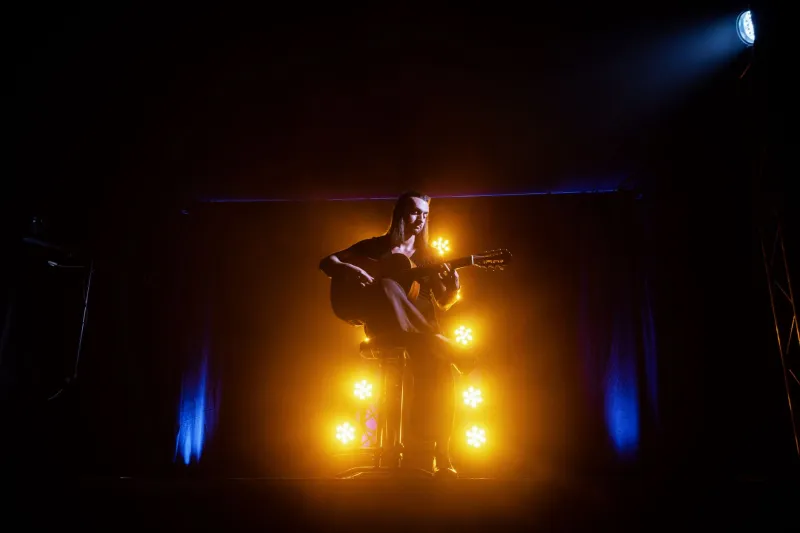
Photo by Photo by Anton Kraev on Unsplash on Unsplash
Somewhere in Coventry in 1983, a seventeen-year-old is playing his copy of The Wall backwards on a belt-driven turntable, convinced — absolutely convinced — that Pink Floyd are communicating directly with him through reversed phonemes and coincidental vowel clusters. He is wrong about the satanic messages. He is, however, accidentally developing an ear for reverse-tape texture that will define his entire creative output for the next four decades.
This is the origin story nobody talks about. The British backwards-masking scene — that gloriously unhinged subculture of conspiracy-minded record collectors who spent the 1980s and early 1990s listening to everything in reverse — gets dismissed as a footnote. A bit of moral panic. A few religious pamphlets. Some concerned parents on Nationwide. But spend any time digging through the actual community that grew out of it, and what you find is something far stranger and far more interesting: a genuine, thriving experimental practice that accidentally bootstrapped itself into legitimacy.
The Panic That Started Everything
Let's be honest about where this began. The backwards-masking hysteria of the early 1980s was, by any reasonable measure, completely barmy. American televangelists were playing Beatles records in reverse to horrified congregations. The British tabloids, never ones to miss a moral panic, duly obliged with their own breathless coverage. The Sun ran pieces. Concerned headteachers wrote letters. The PMRC in the States was demanding warning labels.
In Britain, the response had a distinctly different flavour. Where American evangelicals saw the devil, British enthusiasts — and there were thousands of them, organised through fanzines, cassette exchanges, and eventually early dial-up bulletin boards — tended to treat the whole thing more like a puzzle. Less hellfire, more Ceefax. The question wasn't "is rock music evil?" so much as "what exactly is happening when you reverse this signal, and why does it sound like that?"
That shift in framing changed everything.
From Paranoia to Practice
By the mid-1980s, dedicated communities had sprung up across the UK — in Manchester, Bristol, Glasgow, and a disproportionate number of market towns in the East Midlands — swapping cassette recordings of reversed records through the post. The fanzine Mirror Sound (produced out of a bedsit in Nottingham, photocopied at a local library, circulation approximately 400) was running detailed analyses of which records yielded the most interesting reversed content, rated not on supposed satanic content but on sonic texture.
This is the crucial pivot. People who'd started out looking for hidden messages gradually became obsessed with the sound itself. Reversed reverb tails. Backwards vocal sibilance. The way a snare drum, played in reverse, creates that distinctive cinematic swell that film composers would later exploit extensively. The conspiracy theory was the gateway drug. The actual drug was the texture.
Dave Hollis, who ran Mirror Sound from 1986 to 1991 and now lives in Loughborough, describes the transition with characteristic understatement: "We started off thinking we were investigators. Then one day someone sent in a tape of reversed Cocteau Twins and nobody cared about the hidden messages anymore. We just kept listening to it. It was extraordinary."
The Artists Who Took It Seriously
By the early 1990s, a handful of musicians had begun incorporating deliberate reverse-tape techniques into their work — not as a novelty, but as a core compositional tool. Some came directly from the backwards-masking community. Others arrived independently, having discovered the same sonic territory through different routes: 4-track home recording, the influence of musique concrète, or simply the happy accident of pressing the wrong button.
London-based artist and producer Miriam Chalk has been working with reversed audio since 1994. Her approach is methodical: she records improvised vocal and instrumental passages, reverses them, then improvises again in response to the reversed version, creating layered pieces where the relationship between forward and backward motion becomes the actual composition.
"People assume it's about the spooky factor," she says. "It's not. It's about time. When you reverse audio, you're hearing the decay before the attack. You're hearing the room before the note. It completely changes your relationship to rhythm and melody. It's almost like hearing music the way a bat hears space."
Chalk's work has been performed at venues from the Barbican to a scout hut in Stroud. She credits the British backwards-masking community — however unwittingly — with keeping the technique alive long enough for artists like her to discover it. "Those people were doing serious listening. Obsessive, detailed listening. That's not nothing."
The Technique Today
In the age of digital audio workstations, reversing audio is a single mouse click. Which, paradoxically, has made the analogue approach more interesting, not less. A growing number of UK-based artists are returning to physical tape reversal — manually unspooling cassettes, flipping reels, running reel-to-reel machines backwards — specifically because the process introduces imperfections, speed variations, and textural artefacts that digital reversal doesn't replicate.
Birmingham producer Kel Morrow has built an entire live setup around a pair of modified Revox reel-to-reel machines that he runs in both directions simultaneously, mixing the outputs in real time. His sets — performed most recently at an arts centre in Digbeth and a pub function room in Moseley — are genuinely disorienting in the best possible way, the forward and backward versions of the same source material creating interference patterns that seem to exist in neither direction.
"The conspiracy theorists were listening for something that wasn't there," Morrow says. "But the act of listening that carefully, for that long, for something hidden — that's actually a really valid way to approach sound. You hear things you'd never hear otherwise."
The Unintentional Legacy
Here's the thing about moral panics: they generate enormous amounts of focused attention on their subject. Every teenager who bought a record specifically to play it backwards in the 1980s was, whatever their initial motivation, engaging in a form of deep listening that most music consumption never demands. They were attending to texture, to decay, to the materiality of recorded sound.
Some of them never stopped. Some of them started making music. Some of that music is extraordinary.
The British backwards-masking community didn't set out to create an avant-garde practice. They set out to find the devil in Stairway to Heaven. But the devil, as it turns out, was never the point. The listening was the point. And that particular kind of listening — obsessive, lateral, completely unconcerned with conventional musical value — is very much alive in British experimental music today.
Spin it backwards. You might not hear God. But you'll hear something.